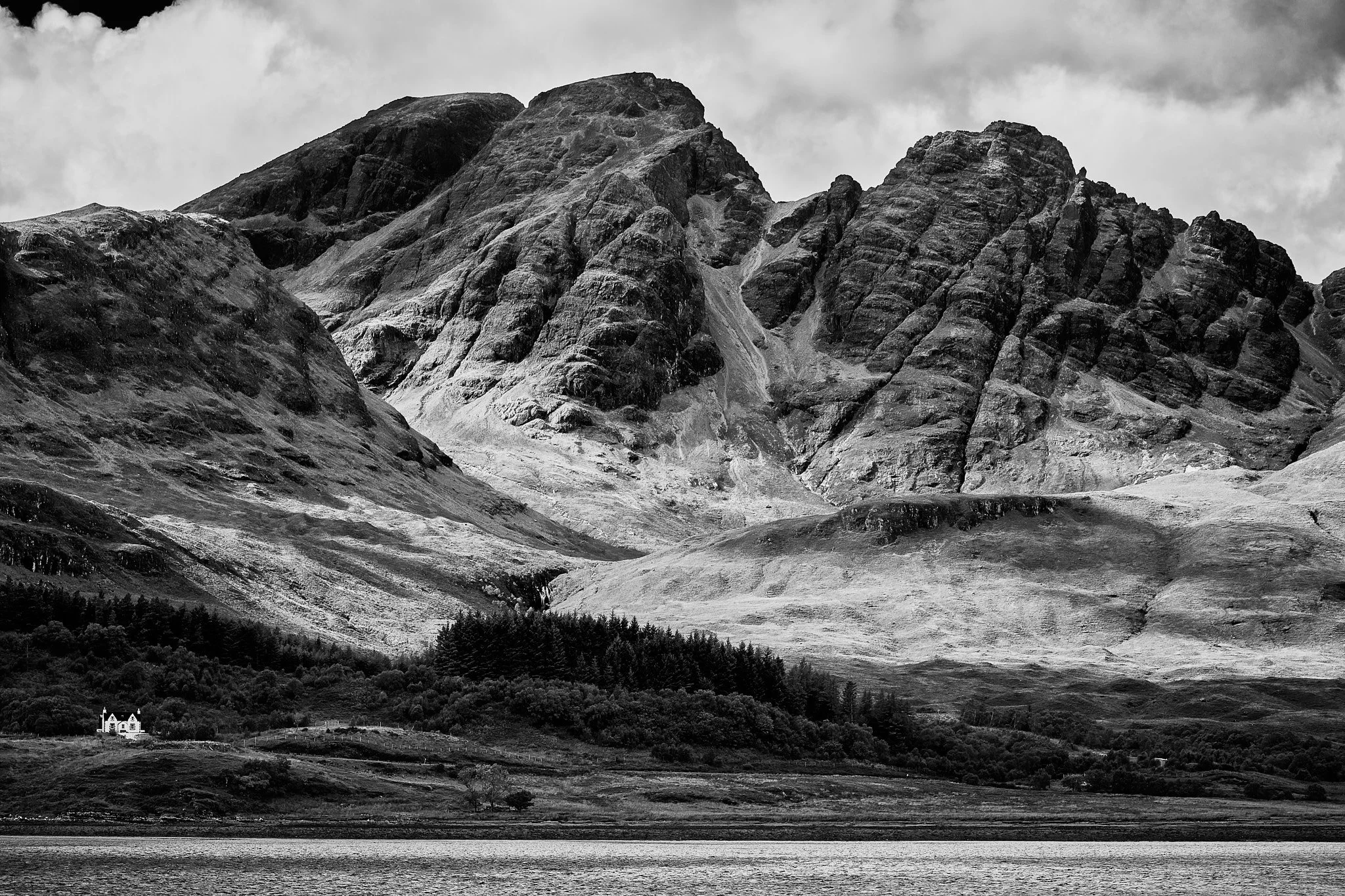
The Isle of Skye

The view from the Quirang looking east towards Scotland, on the northern part of the island.
Recently I realized a long-time desire to attend a landscape workshop with friend and fellow photographer Mark Maio on the Isle of Skye. To say that Skye is a magical place would be an understatement. Roughly 23 miles wide and 50 miles long, it's a sparsely populated volcanic outcrop on the western side of Scotland filled with craggy mountains, abundant waterfalls, grazing sheep, crashing ocean waves and dramatic light. It's a photographer's dream, especially if one likes creating images of the "grand landscape." Long a fan of Ansel Adams and his black and white images, I've always enjoyed traveling to new places and photographing unfamiliar settings, and this was a tableau destined to satisfy. I purposely didn't do too much homework before going, as I find that I respond best to new places sight unseen. If one isn't careful, it can be a bit overwhelming, but personally I've always welcomed the visual challenge nonetheless. Such was my introduction to Skye.

Amy’s Place…a welcome respite to refresh and recharge.
Amy's Place is a tiny, purple-sided roadside oasis that has a rest room...a luxury on this remote part of the island, so we stopped in to get a scone and some refreshment, before spending time photographing Loch Slapin a few yards away. The wind was blowing hard, but the sky was clear, and it stayed that way the rest of the day...an unusual event on Skye.
Loch Slapin
Make no mistake, a trip like this is work. It's enjoyable work, but work nonetheless. Having attended workshops many years ago, I had a pretty good idea of what to expect, or so I thought. Besides myself, there were two non-professional photographers, and I thought that I might be teaching a bit more, which would have been fine by me. One of them turned out to be very experienced, while the third man was relatively new to photography, but he was very keen to learn, and proved to be a willing student too. Often we were left to our own devices once we reached a particular location, which Mark had judiciously selected, due to his almost decade of experience on the island.
To say that life on the island is a challenge would be an understatement. Everything has to be imported from the mainland and as such things that are readily available elsewhere are not always so on Skye, and they can be much more expensive too. Nonetheless, the people that live there are a hardy bunch, and wouldn't dream of living any where else. Most supplement their livelihood with a second form of income, be it tending sheep or cattle, or in many cases, supporting the tourism industry. From what I gathered, it's a double-edged sword for the locals, as they treasure their lifestyle and their rural, relatively isolated way of life.
While the workshop was scheduled for five days, I had to leave after four, to get to an airshow in England where my book on WWII flight jackets would be sold. With that in mind, I made mental notes on things I could do better, if I get the chance to return to the island. In no particular order, here they are:
1. Wear boots that have a good tread (not worn away!), and that solidly wrap the ankle. There are many places where it would be quite easy to break an ankle or leg. Footing is treacherous!
2. Create panoramic images by shooting multiple images with that in mind, or use your iPhone. The opening image is seven frames combined in Capture One to create a print that is 62 inches wide!
3. Walk as much as possible before attending the workshop, while carrying your intended camera load. Skye has some very long steep paths, and the better shape you are in, the more opportunities you'll have to make photographs. The walking can be very taxing over several days.
4. Put your rain jacket in your camera bag to travel with...and a toothbrush/toothpaste too. A change of socks and underwear would also be good, in case your luggage doesn't arrive...like ours didn't.
5. If you plan on using filters, physically check beforehand how they'll be mounted. In my case, I had wanted to do some long exposures with neutral density filters, and assumed that the correct adapter ring was in place on my lens filter holder. It wasn't. Dumb mistake not to check. I made it work, but it wasn't ideal.
6. When moving around from spot to spot, put your camera in a padded case/backpack. It will protect it in case you fall...like I did...twice...once in the mud, and once on wet grass. See note 1.
7. A hat, card, or well-placed hand can serve as a lens shade in a pinch. Note to self.
8. Make sure that your camera's sensor is clean before you arrive. Dust spots stink!
9. Carry some provided snacks with you at all times. Peanuts, energy bars, an apple. Water if possible.
10. Bring a good dose of patience too...and good humor. Nobody likes a whiner.
12. Have a good polarizing filter. You may not use it, but there are times when nothing else works.
13. Consider bringing a good neutral density filter to create long exposures...at least 10 stops.
14. Bring a solid tripod, not one of those flimsy jobs. The wind blows hard on Skye!
It's a workshop after all, so don't be afraid to ask questions. Perhaps your fellow photographers may know the answer, or Mark may know. But feel free to ask, as it's most likely a learning experience for everyone, no matter how experienced they may be. Other things to keep in mind when photographing in a place like Skye...turn around. You'll be surprised at what you see. Look at things up close too. I've come to believe that a mixture of wide angle and narrow view images (shot with a longer lens), and also macro images are a good way to deliver a balanced view of a place. Imagine you are providing images for a story in National Geographic or some similar publication. Notice how they always have a variety of images to please the eye. This is not the time or place to be myopic.
Perhaps most importantly, learn how to look for light. Chiaroscuro is an Italian term that means "an effect of contrasted light and shadow created by light falling unevenly or from a particular direction on something." It can make all the difference in a landscape image. Again, study the masters of the craft.
Feel free to ask questions about image processing. Adobe's Lightroom and Capture One are the main choices for professionals these days, and using them "artfully" can go a long way towards making images that you'll be proud to print and display. Keep the end result in mind when making images.
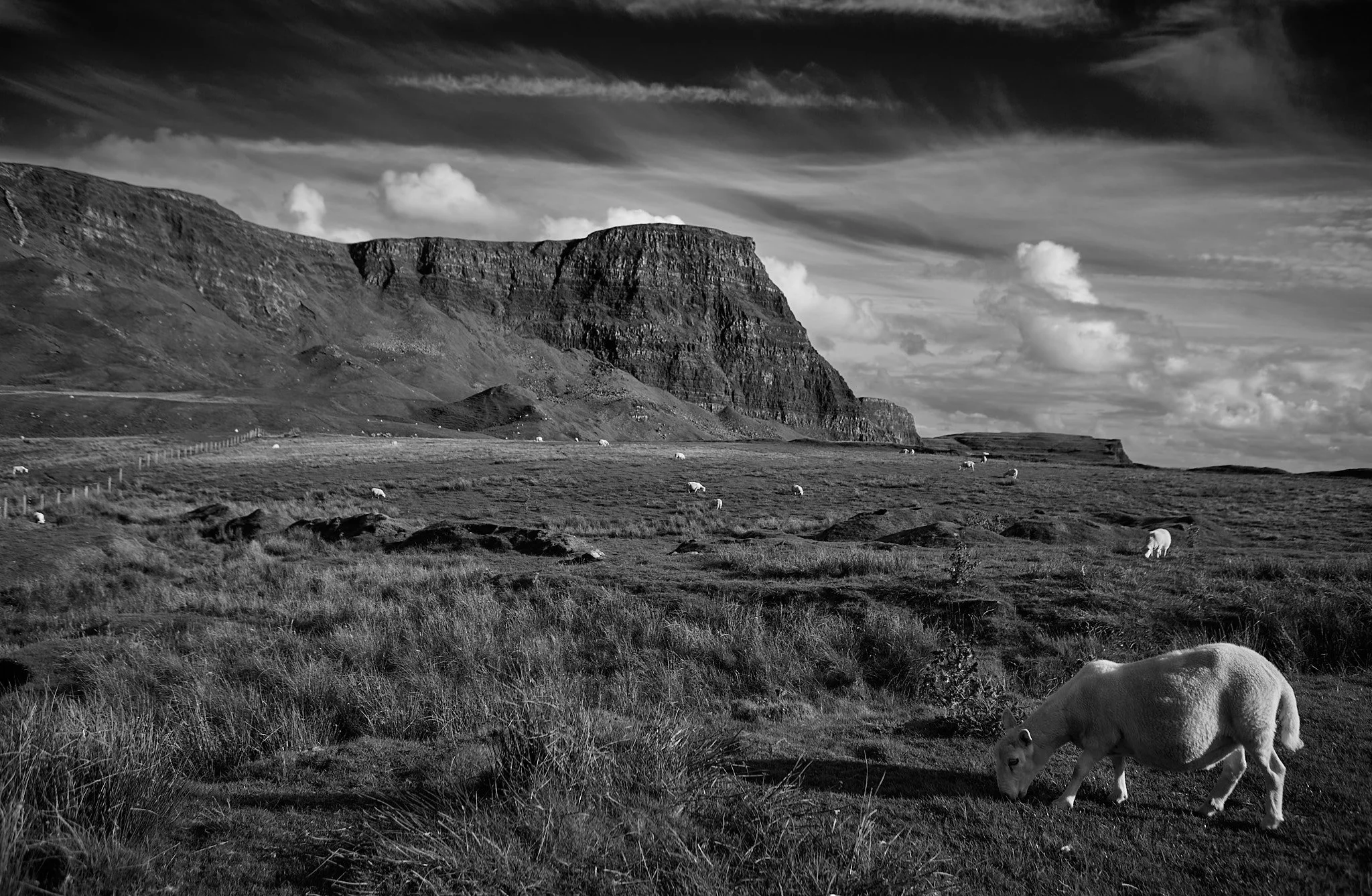
This sheep wandered into the frame, just before I tripped the shutter. Sometimes you just get lucky…
Take advantage of "happy accidents." The sheep wandered into my frame, after the image was all framed up. It made for an interesting counterpoint to the mass of the mountain in the background, not to mention the tonal and textural contrast as well. It also emphasized the rural nature of the island.
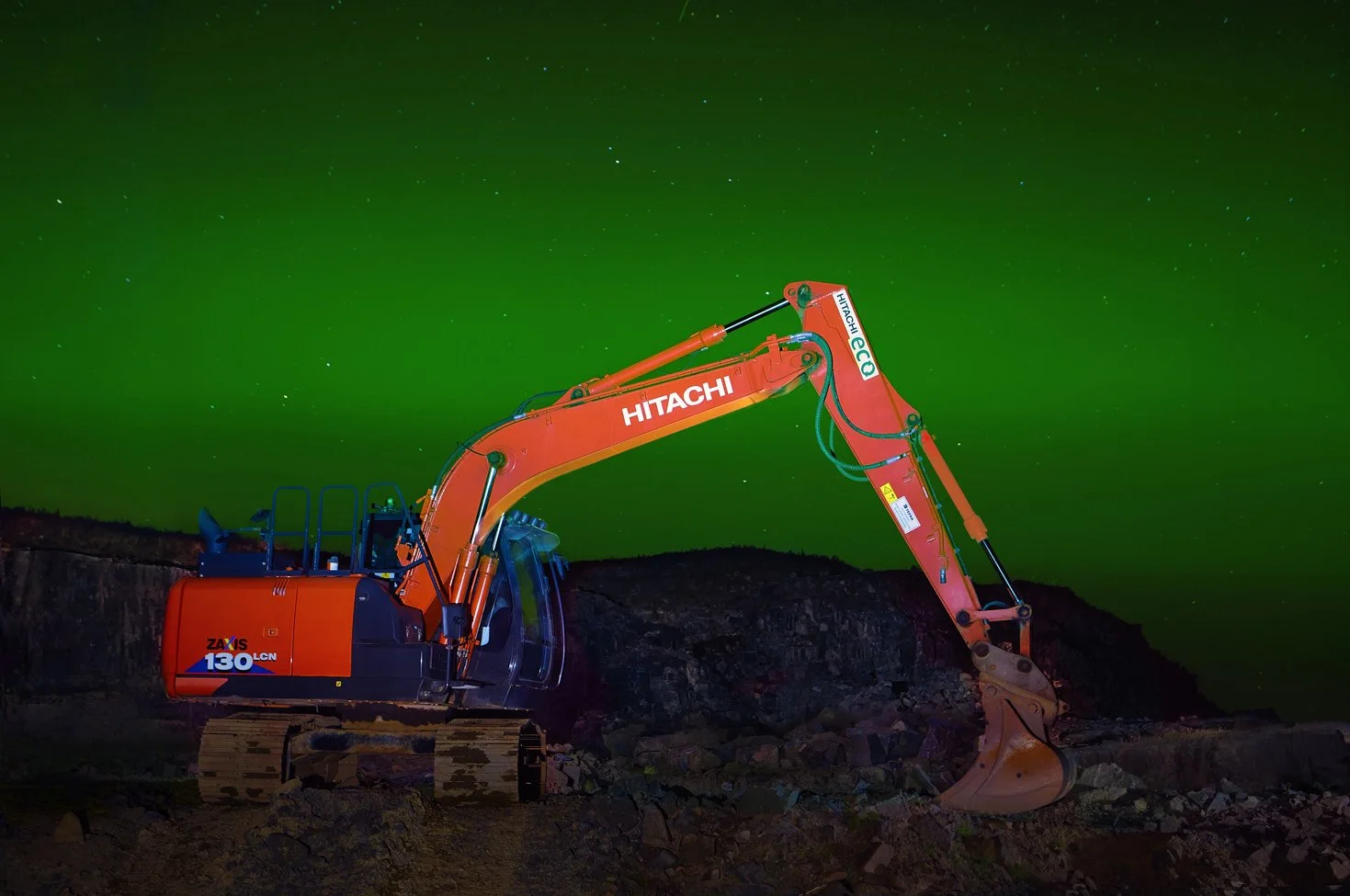
An excavator in a rock quarry with the “northern lights.”
Speaking of happy accidents, on our first day at Lealt Falls, I noticed a relatively new looking excavator in a rock quarry, just a few yards away from the parking lot. Thinking that it might be cool to photograph it at night with star trails, and to do some "light painting," we came back the second night, which was very clear. Imagine my surprise when the Northern Lights made an appearance! Never having seen them before, it took a minute to figure out what was happening. So instead of stars, we had to "settle" for the northern lights. On the off chance that I'd need it, I'd brought my strobe on the trip, and the resulting image was a 20 second exposure with 6 "pops" of the strobe (while the shutter was open) to build up the exposure. The camera was on a tripod and tethered to my laptop (which rested atop my camera bag), so it was straightforward to determine the exposure. We had the basic shot in hand in about 20 minutes. Always keep potential shots in mind, and carry a flashlight too! Focus was achieved in the dark by holding the flashlight next to the excavator, and pointing it back at the camera, which was then manually focused. Easy.
Mark will host another workshop in September 2024 on Skye. Contact him via email, or visit his website for more information.

30 second exposure with a 10 stop neutral density filter.